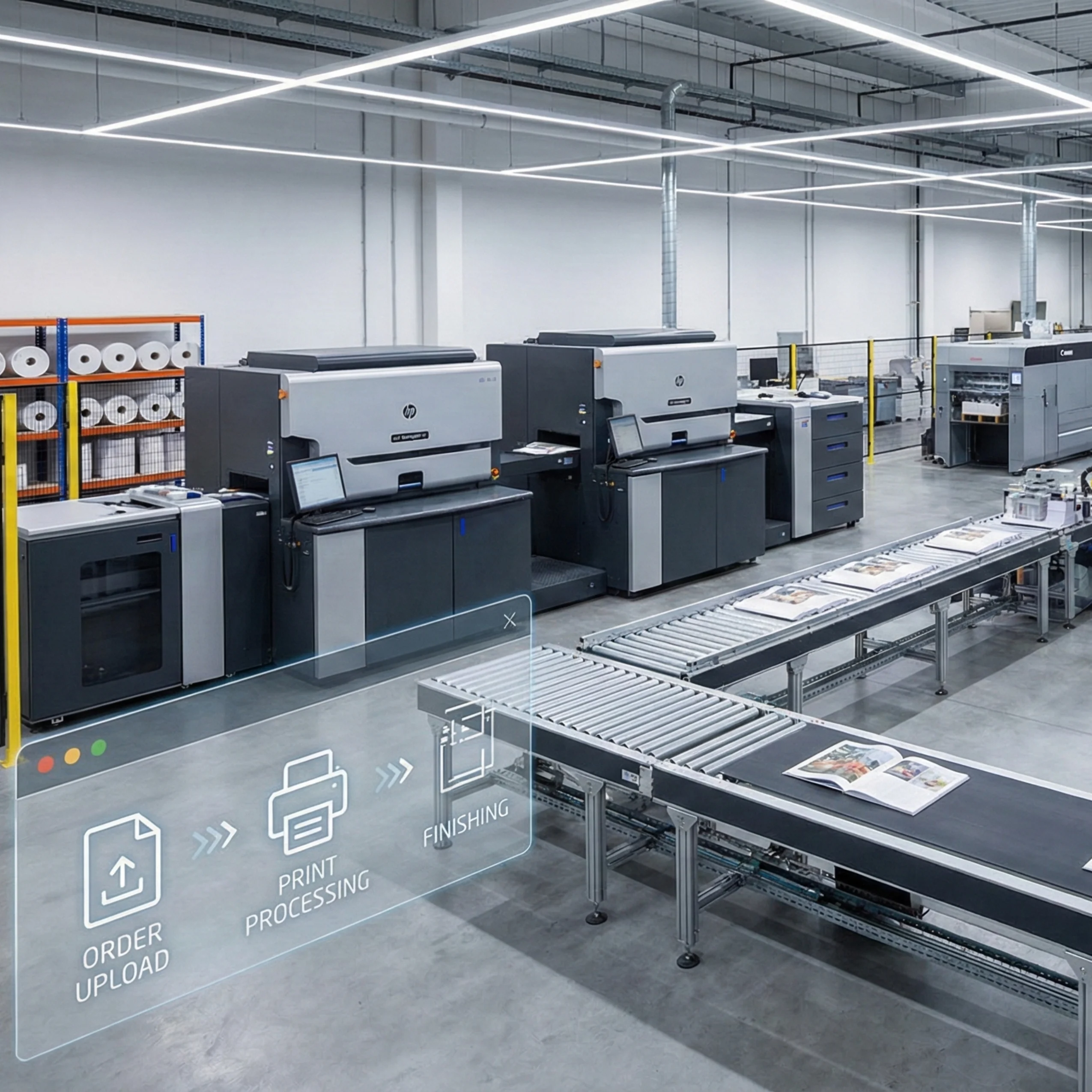
In today’s competitive printing landscape, manual processes are no longer sustainable. With the global web-to-print market projected to reach $44.65 billion by 2032 and businesses demanding faster turnaround times, print automation has become essential for survival and growth. This comprehensive guide explores how web-to-print automation can transform your printing operations, reduce costs, and position your business for scalable success in 2025.
What is Web-to-Print Automation?
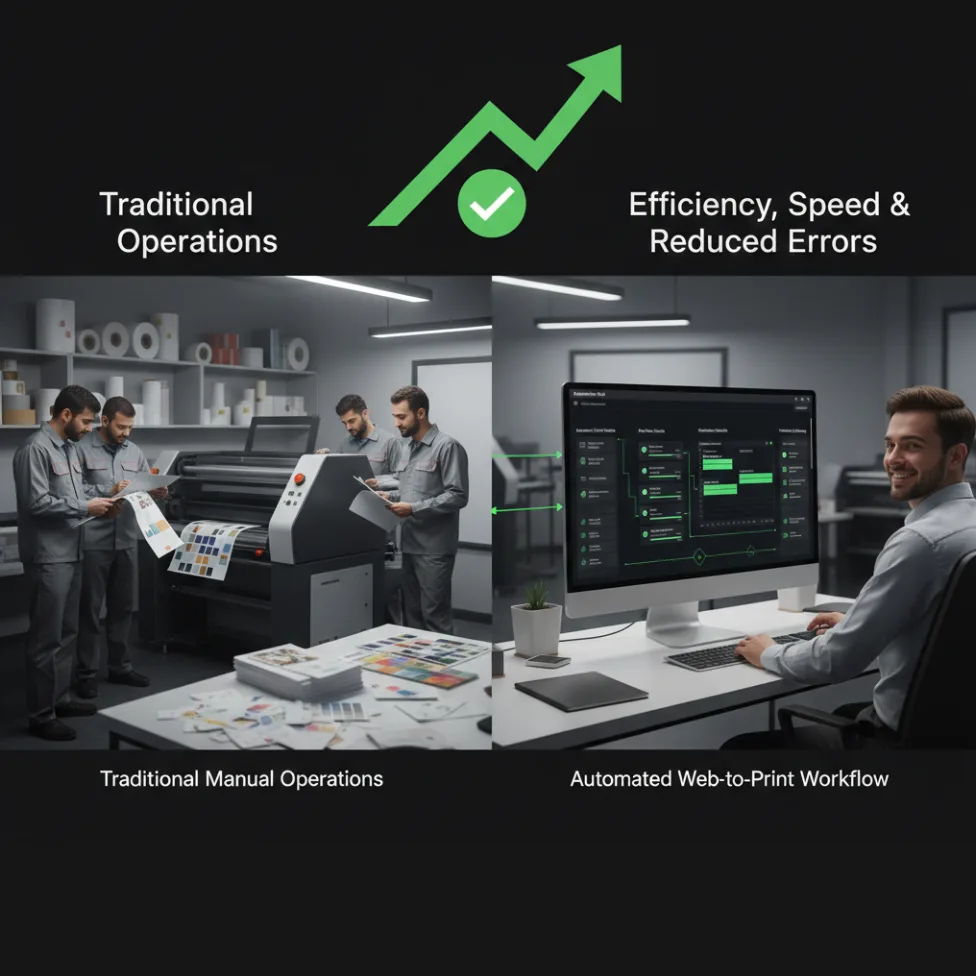
Web-to-print automation encompasses the integration of digital technologies that streamline your entire print production workflow – from initial order intake to final delivery. Unlike traditional printing operations that rely heavily on manual intervention, automated web-to-print systems enable touchless processing, intelligent job scheduling, and seamless integration between customer-facing platforms and production systems.
Modern web-to-print automation combines artificial intelligence, machine learning, and workflow management software to eliminate bottlenecks, reduce human error, and optimize resource allocation. This technology allows print businesses to process thousands of orders daily while maintaining consistent quality and meeting tight deadlines.
The Business Case for Print Automation in 2025
The statistics paint a compelling picture for automation adoption. According to recent industry research, 51% of employees spend at least two hours daily on repetitive tasks that could be automated. For print businesses, this translates into significant productivity gains and cost savings.
Proven ROI from Industry Leaders
Real-world case studies demonstrate the tangible benefits of web-to-print automation. Direct Response Imaging, a small commercial printer, achieved payback on their automation investment within just three months. Their automated system reduced manual order processing from tedious Excel-based workflows to streamlined, automated operations.
Similarly, DPI Inc. processes 3,000 to 4,000 orders daily through their automated system, something that would be impossible with manual processes. As their president noted, “There is no way we could handle this volume without automation. You could throw people at it, but you could never afford to do it that way.”
Citrus College achieved remarkable results with their web-to-print automation implementation, seeing a 50% improvement in job turnaround times and a 17% volume increase without adding staff. This demonstrates how automation enables businesses to scale efficiently without proportional increases in labor costs.
Key Components of Web-to-Print Automation
1. Automated Order Management
Modern web-to-print platforms eliminate manual order entry by enabling customers to submit jobs directly through online storefronts. PrintPoz’s intuitive design tools allow customers to customize products, upload files, and place orders 24/7, reducing the administrative burden on your staff while improving customer satisfaction.
Automated order management systems provide real-time tracking, automatic job routing, and intelligent prioritization based on deadlines and production capacity. This ensures optimal resource utilization and prevents bottlenecks that commonly plague manual operations.
2. Intelligent Pre-Press Automation
Pre-press operations – including pre-flighting, file preparation, and proofing – consume significant time and resources in traditional workflows. Automated pre-press systems can detect and correct common issues like low-resolution images, incorrect color profiles, and improper margins before production begins.
PrintPoz’s comprehensive printing solutions include automated pre-flight checks that identify potential issues early, reducing reprints and material waste. This quality control automation ensures consistent output while minimizing the need for manual intervention.
3. Production Scheduling and Resource Optimization
Automated production scheduling systems analyze incoming orders, available resources, and delivery deadlines to create optimal production sequences. This intelligent scheduling reduces idle time, maximizes equipment utilization, and ensures on-time delivery.
HP Site Flow, a leading workflow automation platform, demonstrates how automated scheduling can consolidate orders, optimize batches, and streamline production to maximize device efficiency. Similar capabilities integrated into PrintPoz’s e-commerce platform enable seamless workflow management from order to delivery.
4. Post-Press and Fulfillment Automation
The final stages of print production – cutting, binding, finishing, and shipping – can also benefit from automation. Barcode-driven finishing systems, automated packaging, and integrated shipping solutions reduce manual touchpoints and accelerate order fulfillment.
Measuring the ROI of Web-to-Print Automation
Calculating Your Automation Investment Return
To determine the financial impact of web-to-print automation, consider these key metrics:
Cost Reduction Factors:
- Reduced labor costs through task automation
- Minimized material waste through optimized production planning
- Decreased error rates and elimination of costly reprints
- Lower administrative overhead through streamlined processes
Revenue Enhancement Factors:
- Increased order capacity without proportional staff increases
- Faster turnaround times enabling premium pricing
- 24/7 order acceptance through automated storefronts
- Improved customer satisfaction leading to repeat business
Sample ROI Calculation
Consider a print business processing 1,000 jobs monthly with current manual costs of $12 per job. With automation reducing processing costs to $3 per job:
- Monthly savings: (1,000 × $12) – (1,000 × $3) = $9,000
- Annual savings: $108,000
- If automation implementation costs $40,000, ROI = ($108,000 – $40,000) / $40,000 = 170%
This conservative calculation doesn’t include additional benefits like increased capacity, reduced error rates, or premium pricing opportunities.
Implementation Strategy: Your Web-to-Print Automation Roadmap
Phase 1: Assessment and Planning (Weeks 1-4)
Workflow Analysis Checklist:
- Document current order processing times and costs
- Identify manual bottlenecks and repetitive tasks
- Analyze error rates and associated costs
- Evaluate current capacity constraints
- Assess integration requirements with existing systems
Goal Setting:
- Define specific automation objectives (e.g., reduce processing time by 50%)
- Establish ROI targets and timeline expectations
- Identify key performance indicators for success measurement
Phase 2: Platform Selection and Setup (Weeks 5-8)
Choose a comprehensive web-to-print solution like PrintPoz that offers:
- Intuitive design tools for customer self-service
- Automated order processing and job routing
- Integration capabilities with existing production systems
- Scalable cloud-based architecture
- Real-time analytics and reporting
Integration Considerations:
- CRM system connectivity for customer management
- Accounting software integration for automated billing
- Production equipment compatibility
- Shipping carrier integration for fulfillment automation
Phase 3: Pilot Implementation (Weeks 9-12)
Start with a subset of products or customer segments to minimize risk:
- Configure basic product templates and pricing rules
- Set up automated workflows for selected job types
- Train initial staff on new processes
- Monitor performance metrics and gather feedback
Phase 4: Full Rollout and Optimization (Weeks 13-16)
- Expand automation to complete product catalog
- Implement advanced features like AI-powered recommendations
- Optimize workflows based on pilot phase learnings
- Provide comprehensive staff training on all system capabilities
Advanced Automation Features for 2025
Artificial Intelligence Integration
The latest web-to-print platforms incorporate AI for enhanced automation capabilities:
- Smart Design Recommendations: AI analyzes customer preferences to suggest relevant products and designs
- Predictive Analytics: Machine learning algorithms forecast demand and optimize inventory
- Automated Customer Service: AI chatbots handle routine inquiries 24/7
- Quality Control: Computer vision systems detect defects and inconsistencies automatically
Mobile-First Automation
With mobile commerce growing rapidly, ensure your automation strategy includes mobile-optimized design tools and responsive customer interfaces. PrintPoz’s mobile-friendly platform enables customers to create and order custom products from any device, expanding your market reach.
Sustainability Through Automation
Environmental consciousness drives printing decisions, with 80% of consumers considering sustainability. Automation supports eco-friendly practices through:
- Optimized material usage reducing waste
- Digital proofing eliminating physical samples
- Efficient routing minimizing transportation impact
- Data-driven decisions supporting sustainable practices
Overcoming Common Implementation Challenges
Technical Integration Hurdles
Many businesses worry about integrating new automation systems with existing infrastructure. Choose platforms that offer robust APIs and proven integration capabilities. PrintPoz provides comprehensive technical support to ensure seamless integration with your current systems.
Staff Resistance and Training
Address automation concerns through transparent communication about benefits and comprehensive training programs. Emphasize how automation eliminates tedious tasks, allowing staff to focus on higher-value activities like customer relationship building and strategic planning.
Quality Control Concerns
Automated systems can actually improve quality consistency through standardized processes and real-time error detection. Implement gradual rollouts with thorough testing to build confidence in automated quality control systems.
Future-Proofing Your Print Business
Scalability Planning
Choose automation solutions that grow with your business. Cloud-based platforms like PrintPoz offer scalable infrastructure that handles increased order volumes without requiring additional hardware investments.
Data-Driven Decision Making
Leverage automation-generated data for strategic insights:
- Order pattern analysis for inventory optimization
- Customer behavior tracking for targeted marketing
- Production efficiency metrics for continuous improvement
- Profitability analysis by product category
Competitive Differentiation
Automation enables service offerings that manual operations cannot match:
- Same-day turnaround for rush orders
- 24/7 customer self-service capabilities
- Personalized product recommendations
- Real-time order tracking and updates
Conclusion: Embracing the Automated Future
Web-to-print automation is no longer a luxury – it’s a necessity for print businesses seeking sustainable growth in 2025. The combination of reduced costs, increased capacity, improved quality, and enhanced customer experience creates a compelling business case for automation investment.
Companies like PrintPoz are leading this transformation by providing comprehensive automation solutions that address the complete print workflow. From intuitive design tools and seamless e-commerce integration to automated production management and fulfillment, these platforms enable print businesses to compete effectively in today’s digital marketplace.
The question isn’t whether to automate – it’s how quickly you can implement these technologies to capture their benefits. Start your automation journey today by assessing your current workflows, identifying optimization opportunities, and selecting a platform that supports your growth objectives.
Ready to transform your print business with automation? Explore PrintPoz’s comprehensive web-to-print solutions and discover how automation can streamline your operations, reduce costs, and accelerate growth in 2025.